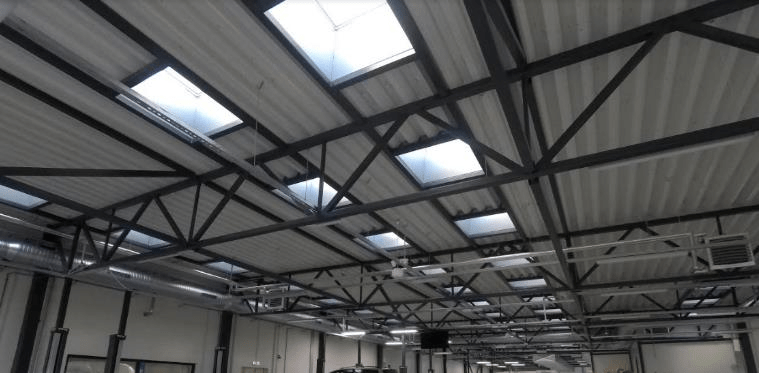
There is never a specific solution in respect of rooflight area – judgement is required on a project by Ofset project basis. However, the example shown below, demonstrates how data can be interpreted to inform a decision.
The first consideration in establishing rooflight area, is the use of the building. As a typical example, in retail and manufacturing areas, the recommended light level is 500 Lux.
Establishing the appropriate rooflight area to achieve the desired light level is the next point to consider. The larger the rooflight area, the more hours each year the required light level will be provided by natural light. This is the crucial factor affecting energy and emissions reductions – as during these hours, the need for electric lighting is removed.
rooflight areas will affect illumination levels
The graph above shows how rooflight areas will affect illumination levels. In this example for a single storey building located in London, between the hours of 6am and 6pm daily, with rooflights providing 50% light transmission. You can see that as the rooflight area along the bottom of the graph increases, the length of time a given illumination level is achieved, is extended.
So for a building requiring 500 Lux, looking at the yellow line, you can see that with 10% rooflights, 500 lux would be achieved for approximately 2000 hours or 46% of the working year.
If rooflight area is increased to 15%, 500 lux is then available for just over 2500 hours, or 58% of the working year. So a building with 10% rooflights will require electric lights to be turned on for approximately 30% more hours per year than if the building was fitted with 15% rooflights.
How rooflight area affects light levels, energy costs and CO2 emissions
It’s important to note that the savings will only be made if the lights are switched off during periods when they are not required and for this reason automatic lighting controls should always be specified as part of the project.
Recent research carried out by Elmhurst Energy supports these figures and gives detailed savings in building running costs resulting from improving daylight levels and installing lighting controls in existing buildings. The results show savings in running costs of up to £5.92/m2/yr, and savings of CO2 emissions up to 28.7kg CO2/m2/yr can be achieved, with results from industrial and retail buildings very consistent. Slightly lower savings were achieved in the rooflit areas of a school (savings in running costs of £2.92/m2/yr, and savings of CO2 emissions of 14.7kg CO2/m2/yr) primarily because significant sections of the rooflit areas were also well lit by windows, reducing the effect of improved illumination through rooflights.
These figures demonstrate that correctly specified rooflights will provide an outstanding long-term returns on investment with short payback periods – as well as contributing to improved sustainability credentials for the building occupier.
 Site Title
Leave a comment